
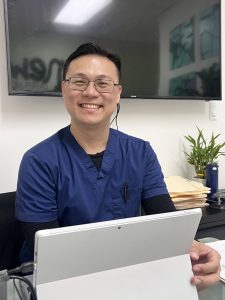
Dr. William Lin L.Ac
Written and clinically reviewed by Dr. William Lin L.Ac.
Licensed Acupuncturist, State of California — License No. 19748.
Master of Science, Traditional Chinese Medicine and Chinese Herbology, South Baylo University.
Last reviewed: October 01, 2026
Most people who sit down in my treatment room have already tried other things. They’ve had the imaging. They’ve taken something for it. They did the stretches for a few weeks. Usually something helped a little, or helped for a month and then stopped, and now they’re here mostly because they’ve run out of other ideas.
That’s a reasonable time to try acupuncture. The problems that hang around like that — the ones nobody can quite explain — are the ones this kind of treatment tends to be useful for.
Let me explain what I, and other Acupuncturists actually do.
What Acupuncture & Acupressure Is, and how I approach Patients' Concerns
Acupuncture is the placement of very thin sterile needles at specific points on the body. Acupressure works those same points with my hands instead. I do both, and I’ll often use some of each in a single visit depending on what your body seems to want that day.
The part people don’t expect is how much of the work happens before any needle comes out.
Chinese medicine treats the body as one connected system rather than a set of separate parts, so my job at the first visit is to find the pattern underneath your symptom. That’s why I’ll ask about your sleep when you came in for headaches, or about your digestion when your complaint is fatigue. I’m not making small talk. Those answers usually tell me more about what’s driving the problem than the problem itself does.
I also check your pulse and look at your tongue. Patients find this the strangest part, so here’s the honest explanation: I’m feeling for qualities in the pulse — depth, speed, whether it feels tight or thin — at several positions on each wrist, and the tongue tells me about coating, color and shape. Between them I get information I can’t get from asking questions. It takes about two minutes and it’s how I decide which points to use.
Here’s the practical difference. Two people can walk in with what looks like identical lower back pain and leave with completely different treatment plans, because the reason behind the pain usually isn’t the same. I don’t work from a back-pain protocol. I work from what I find in front of me protocol.
Why it takes more than one visit
Researchers describe acupuncture in terms of how needling affects the way your nervous system handles pain signals and the regulatory responses your body already has. I’d put it more simply: I’m not switching something off, I’m nudging a system that’s gotten stuck back toward where it should be. That’s why treatment usually builds over a course of visits rather than fixing everything on day one — and why, when it works, it tends to hold.
About Acupressure
I want to be clear that this isn’t a lesser option. It’s the same points, the same diagnosis, the same thinking, worked with steady hand pressure and the bodywork that belongs to the same tradition. I use it with people who’d rather not be needled, people on blood thinners, and anyone who just wants to start gently. Some patients stay with it the whole way through. That’s completely fine.
What People Come to Me For
Pain and Injury
- Low back pain, recent or long-standing
- Neck and shoulder tension or pain
- Sciatica
- Knee and hip pain, including osteoarthritis
- Recovery after a car accident or a work injury
Headaches and Nerve Concerns
- Migraines and tension headaches
- Numbness, tingling, and nerve pain
Stress, Sleep, and Digestion
- Trouble Sleeping
- Stress, and the way it shows up in your body
- Digestive problems that never quite settle
Women's Health
- Painful or Irregular Periods
- Fertility Support
- Menopausal Symptoms
Does Acupuncture Actually Work?
For a lot of what I treat, yes — and I’d rather give you a straight answer than a sales pitch.
The clearest case is chronic low back pain. It’s the most studied use of acupuncture there is, and the American College of Physicians includes it among the non-drug treatments they recommend trying before medication. Arthritis of the knee, hip or hand and migraine are close behind, and both are recommended by the specialty bodies that look at this.
Beyond that, most of what I treat comes down to the same idea. Chinese medicine works on the principle that the body has channels through which circulation and energy move, and that when something in that system gets blocked or stuck, symptoms follow — pain in one person, poor sleep in another, digestion that won’t settle in a third. Acupuncture and acupressure open those channels back up so the body can get on with its own repair work.
That’s why the list of what I treat looks so broad. It isn’t that acupuncture does a dozen unrelated things. It’s that a dozen different complaints often trace back to the same underlying restriction. Carpal tunnel, irritable bowel, sciatica, headaches, menstrual problems, fertility concerns, the general run-down feeling that nobody can put a name to — I see all of these regularly.
I start from what you’re actually dealing with. You tell me what’s been going on, I work out which channel is involved, and the treatment goes there. The symptom tells me where to look. The channel tells me what to do about it.
What Actually Happens in a Visit?
1. Arrival & Check-In
The front desk takes care of the paperwork, and then you’re shown to an exam room. Nothing happens in a waiting room chair — you’re in the room before we start.
2. Listen to Understand
I come in and I listen. You tell me what’s been going on, where it hurts, how long it’s been like that, what makes it worse. This part isn’t rushed, and it isn’t a form. I’ll ask about things that might seem unrelated — sleep, digestion, how your days actually go — because they usually tell me something the main complaint doesn’t.
3. Sharing Findings & Diagnosis
You get my read on what’s happening and why, in plain language, before anything begins. If I think something else is going on that needs a physician, I’ll say that too.
4. Treatment in the Same Room, on the Same Day
There’s no separate consultation appointment. What the treatment involves depends on what your body needs — acupuncture, acupressure, direct heat compress therapy, red light therapy, infrared therapy, herbal paste applied at specific points, or more often some combination of them working together.
5. Rest & Recovery
Once the treatment is in place I leave you for a while so your body can absorb it and settle. This isn’t downtime — it’s part of how the treatment works. A lot of people fall asleep, which I take as a compliment.
6. Re-Evaluation after Body has time to Adapt
I’ll ask how you’re feeling and what’s changed. You know your own body better than I do, so if something is still sitting there, tell me — I’ll treat it again before you get up. I’d rather deal with it while you’re here than have you notice it in the car.
7. Herbs, if you need them
Depending on what’s going on and how severe it is, I may prescribe custom Traditional Chinese herbs for you to take at home. Every formula is made for the individual, with instructions for exactly how to take it.
8. Before you Leave...
I’ll tell you whether I think you need another session and roughly what the course looks like. If you do, the front desk books it on your way out. If you don’t, I’ll say that too.
How much does Acupuncture Cost?
Pricing
First Visit (Full Intake, Examination, Diagnosis, & Treatment)
Follow-Up Visits (May be covered by Insurance)
Payment is charged at the time of your visit. Before that first appointment my office checks your insurance and tells you what if Acupuncture is covered, so you’re not guessing and there’s no surprise afterward.
One thing worth knowing up front: most insurance plans don’t cover the initial Chinese medicine consultation (the history, the pulse and tongue diagnosis, the treatment planning) but they often do cover follow-up visits and therapies. It varies by plan, which is why we look up your plan details first.
We work with most major insurance plans, Medicare, workers’ compensation, and auto accident claims.
Coverage depends on your individual plan, which is why we check it before your first visit rather than after.
Questions I get Asked
Does it hurt? Not the way people expect. The needles are hair-fine and what patients usually describe is a dull heaviness rather than pain. If you’re nervous, tell me — I can keep the first treatment very light, or use acupressure instead and save the needles for another day.
Can I do acupressure only? Yes. Some people do it that way from start to finish. Depending on the severity of your symptoms needles penetrate deeper into the channels, however, acupressure is just as effective if not more effective to promote your blood flow.
How many sessions will I need? It depends mostly on how long you’ve had the problem. Recent pain or injuries sometimes settle in a few visits, however, long-standing things usually take a course. When you come in for an initial consultation and visit we’ll walk through your treatment plan together.
Will it interfere with my medications or my doctor’s treatment? No. Acupuncture is meant to work alongside regular medical care. Don’t put off seeing a doctor about something, and please don’t stop a prescription without talking to your doctor that prescribed it. Bring a list of what you’re taking to our first session and we’ll review your treatment together.
How soon will I know if it’s working? Usually within the first few visits you’ll notice something shift — less intense, less often, or not lasting as long. I’ll tell you what to watch for and roughly when.
Are you licensed? Yes. I am a Licensed Acupuncturists in California – Acupuncture license number 19748, in good standing with the California Acupuncture Board. It’s public record and you’re welcome to look up my credentials.
Come In and we'll talk about how Acupuncture & Acupressure can help
If you’re not sure acupuncture is right for what’s going on, I’d rather have that conversation before you book than after. Call either office, or send a request and we’ll get back to you.
Pico Rivera · 6505 Rosemead Blvd, Ste 200, Pico Rivera, CA 90660
Chino · 15338 Central Ave, Chino, CA 91710
— Dr. William Lin, L.Ac.